

If you’re planning a new build or upgrading an existing property, choosing between a Traction and a Hydraulic elevator is one of the biggest technical decisions you’ll face. While they both get you from point A to point B, the “how” behind the movement changes everything—from installation costs to how much you’ll pay in electricity.
Here is a breakdown of how these two systems stack up against each other.
1. Hydraulic Elevators: The Heavy Lifters
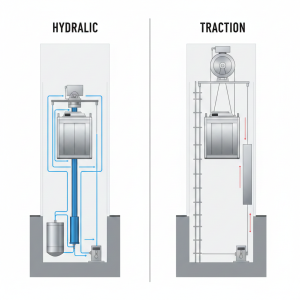
Think of a hydraulic elevator like a high-powered car jack. These systems use a fluid-driven piston located at the bottom of the elevator shaft to push the cab upward.
How They Work
An electric motor pumps oil into the cylinder to move the piston. When the elevator needs to go down, the system simply opens the valves and lets gravity do the work, slowly releasing the oil back into the reservoir.
The Pros & Cons
-
Pro: Lower Initial Cost. Generally cheaper to install than traction systems.
-
Pro: Space-Saving (Above). They don’t require a bulky machine room at the top of the building.
-
Con: Speed & Height. They are relatively slow and usually limited to buildings with 2–6 floors.
-
Con: Environmental Risk. There is a small risk of oil leaks, which can be a concern for underground soil contamination.
2. Traction Elevators: The Speedsters
Traction elevators are the industry standard for modern mid-to-high-rise buildings. Instead of being pushed from below, the cab is pulled from above using steel ropes or belts and a counterweight.
How They Work
The ropes pass over a wheel (sheave) attached to an electric motor. The counterweight balances the cab, meaning the motor only has to move the difference in weight between the two—making it incredibly energy efficient.
The Pros & Cons
-
Pro: Unlimited Height. Since they don’t rely on a piston, they can go as high as the cables allow.
-
Pro: Superior Speed. Much faster and smoother than hydraulic models.
-
Pro: Energy Efficiency. The counterweight system uses significantly less power.
-
Con: Cost. Higher upfront installation and maintenance costs.
-
Con: Maintenance. More moving parts (cables, sheaves, governors) mean more items to inspect.
Which One Should You Choose?
Choose Hydraulic if: You are working on a low-rise residential building or a small office where the budget is tight and the elevator won’t be in constant use.
Choose Traction if: You are building anything taller than five stories, or if you prioritize energy efficiency, speed, and a high-end “smooth” feel for your passengers.
Pro Tip: If you want the benefits of traction but are tight on space, look into MRL (Machine Room-Less) traction elevators. They stow the motor inside the shaft, giving you the best of both worlds.

Leave A Comment